
A lecture becomes interactive when it stops every few minutes and gives the room something to do: a poll, a question to a neighbour, a line to write. None of it needs a new deck. With Diaposi Session, the polls and the anonymous questions run on the slides you already present, and everyone follows on their own phone.
Why does a lecture need regular resets?
Listening for an hour is hard work, and a room that only listens drifts. A reset is any moment where people stop receiving and do something: answer, write, talk to a neighbour. It takes two minutes, and it gives you what an hour of talking cannot: a view of what the room has understood so far.
Which ten techniques work?
- Think-pair-share. A question, a minute alone, two minutes with a neighbour.
- A poll before you explain. Ask for a prediction, then show who was right.
- A poll after you explain. The same question, to see what changed.
- Skeleton notes. A handout with gaps the room fills in as you go.
- The minute paper. One minute to write the main point of the last section.
- The muddiest point. One line on what is still unclear.
- Anonymous questions. Collected all session, answered at set moments.
- A worked example with a mistake in it. The room finds the error.
- A one-word round. A word cloud to open or close a topic.
- A two-question quiz. Before the break, on what was just covered.
How do you fit them into 50 minutes?
Pick three, not ten. Open with a poll, place one activity near the middle where the hard idea sits, and close with a minute paper or a short quiz. Every technique above has a version with no technology at all. The live version adds two things: everyone answers, not only the confident few, and you see the count.
For bigger rooms, see how to keep a large lecture engaged. For the whole picture, see how to make a presentation interactive.
How Diaposi Session helps
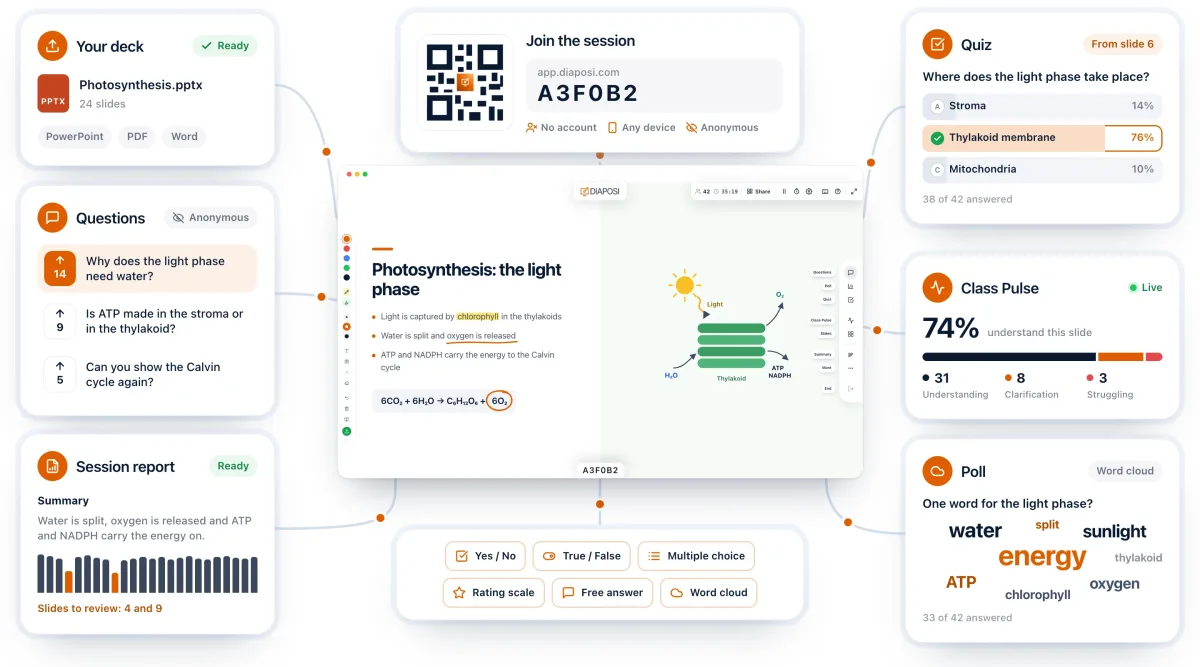
Diaposi Session runs the live versions on the slides you already present: six kinds of poll, including a word cloud, quizzes built from your own slides, and anonymous questions the room votes up. Participants follow on their own phone and can go back to any slide you have shown, so a reset does not lose the people who were still writing.
Diaposi Session is part of Diaposi, the EdTech platform for interactive and measurable learning. Discover Diaposi Session
Frequently asked questions
How often should a lecture pause for an activity?
- A common rhythm is a short activity every 15 to 20 minutes, which gives a 50-minute lecture two or three. Fewer, well-placed activities work better than many rushed ones.
Do interactive lectures cover less content?
- Slightly less is presented, and more of it is understood. An activity takes two or three minutes. In return you learn what the room has not understood while there is still time to explain it again.
Is Diaposi free?
- Yes. Diaposi is free, and there is no paid plan today.