

Active learning means people do something with the material while they are in the room: answer, discuss, write, solve. It is the opposite of listening for an hour and hoping it sticks. You do not need a new course to start, only a few moments where the room answers. Diaposi Session adds those moments to the slides you already have.
What is active learning?
Active learning is any teaching in which people do something with the material during the session instead of only listening to it: answer a question, solve a problem, explain an idea to a neighbour, write a summary. The activity can take one minute. What makes it active is that everyone in the room has to think, not only the person at the front.
What is the evidence?
The largest review so far is Freeman and colleagues, PNAS 2014, which pooled 225 studies of undergraduate science, engineering and mathematics courses. Exam scores were about 6% higher in sections with active learning, and people in traditional lecture sections were 1.5 times more likely to fail. The studies cover those subjects and that level, so the finding should not be stretched to every room. It is still the strongest result there is on how a session is run.
How do you start?
- Ask before you tell. A prediction poll at the start of a topic.
- Pause for a written minute after each main idea.
- Use pairs. One question, two minutes with a neighbour.
- Let the room find the mistake in a worked example.
- Close with a check, not with a summary you give yourself.
The usual objection is time. Each of these takes one to three minutes, and what they cost in content they return in what the room keeps. Ten more techniques are in how to make a lecture interactive, and how to measure engagement in a live session shows how to see whether they worked.
How Diaposi Session helps
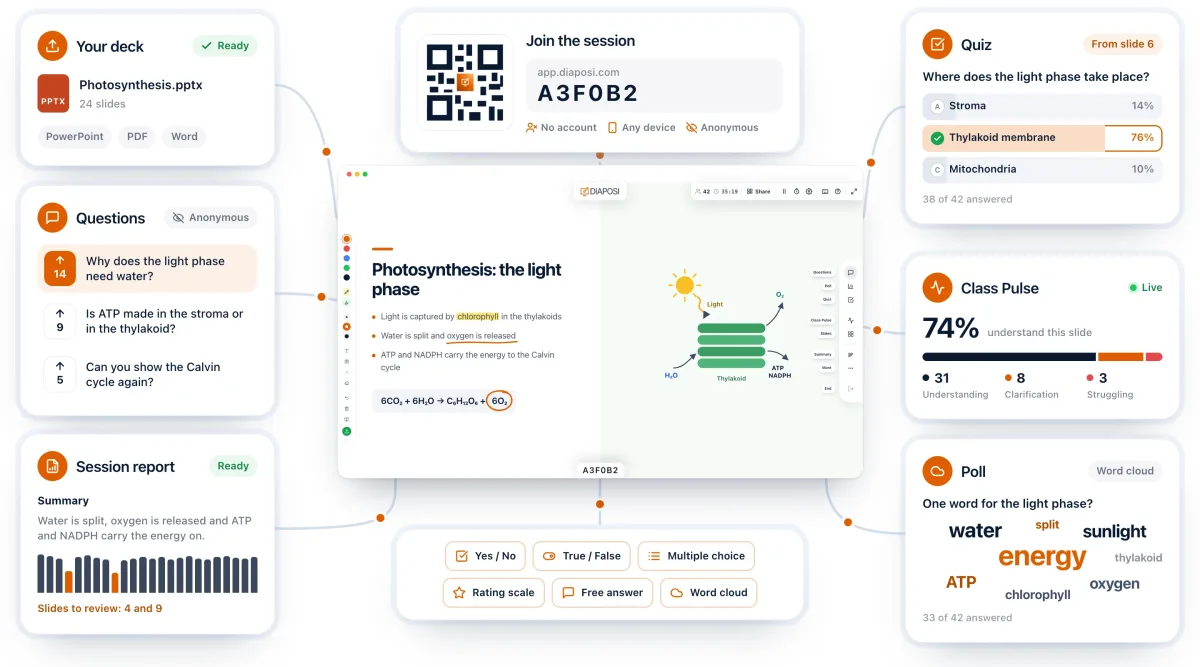
Diaposi Session adds these moments to the slides you already have, so starting does not mean rewriting a course. Polls, quizzes built from your slides and anonymous questions run on your own PowerPoint, PDF or Word file, and everyone answers from their phone. The report then shows, slide by slide, where the room took part and what it understood.
Diaposi Session is part of Diaposi, the EdTech platform for interactive and measurable learning. Discover Diaposi Session
Frequently asked questions
Is active learning the same as group work?
- No. Group work is one form of it. A poll answered alone, a minute of writing or a question to a neighbour are all active learning: the test is whether everyone has to think.
Does active learning work in large lectures?
- Yes. The review by Freeman and colleagues (PNAS 2014) found a benefit in classes of all sizes, with the largest effect in small ones. In a large room the activities change, with polls and neighbour discussion replacing open discussion.
Is Diaposi free?
- Yes. Diaposi is free, and there is no paid plan today.