How do you do active recall with lecture notes?
Close the notes before you study them, not after. Active recall means producing the lecture from memory first, then opening the notes only to check. One lecture takes about 25 minutes, two sheets of paper and a pen of another colour. Do it the evening of the lecture or the next day.
Close the notes and write for ten minutes
On a blank page, write the lecture's title, then everything you remember: ideas, definitions, examples, diagrams. Order and wording do not matter. Stay the full ten minutes, even if you feel empty at minute four.
Open the notes and mark your page
In another colour, tick what is right, correct what is wrong and add what is missing. Be strict: an idea you wrote but could not explain counts as missing.
Turn each gap into a question
On the second sheet, write one question for each correction and each missing idea, with the page of your notes beside it. This gap list is what you study from now on.
Answer the gap list once, notes closed
Straight away. It takes two or three minutes and is the first repair.
Come back twice
Two or three days later, answer the gap list from memory and check. A week later, redo the blank page for the whole lecture. A question you get right twice leaves the list.
What does active recall look like on one lecture?
Take a first-year economics lecture on price elasticity of demand: four pages of notes. Here is what a blank page can look like after ten minutes, checked against them.
| In the notes | On the blank page | Mark | Goes on the gap list |
|---|---|---|---|
| The definition and its formula | How strongly demand reacts to a change in price. No formula. | Partly | Write the formula for price elasticity of demand. |
| Elastic and inelastic demand | Above 1 is elastic, below 1 is inelastic. | Right | Nothing |
| Four things that make demand more elastic | Close substitutes. Luxuries. | Partly | Name the four determinants of elasticity. |
| The link with total revenue | Nothing. | Missing | Demand is inelastic and the price rises. What happens to revenue, and why? |
| The lecturer's example: petrol in the short run | Petrol is inelastic in the short run. | Right | Nothing |
Fifteen minutes in, the lecture has shrunk to three questions. Rereading the four pages would have produced no list: every line looks familiar while it is in front of you.
Blank page or questions: which form of recall should you use?
Both, in that order. The blank page shows what you hold of the whole lecture and how its ideas connect; questions then go after what it missed.
A meta-analysis of 61 laboratory studies, mostly on word pairs and word lists, compared testing with restudying. Where the first test was followed by feedback or had been mostly successful, recalling freely (the blank page) and answering a cue (the question) helped about equally. Both helped more than recognising the right answer among several, which still beat restudying (Rowland, 2014 (external link)).
| What the lecture was made of | What to produce, notes closed |
|---|---|
| Definitions and terms | Each term in one sentence, with an example of your own. |
| A mechanism or a process | The steps in order, and what causes each one. |
| A diagram, a graph, a structure | Draw it, label it, then write what it shows. |
| A worked problem or a proof | Solve it again on a blank page, then change one value and solve that. |
| An argument, a theory, a case | The claim, the evidence for it, one objection. |
| A list of names, dates or values | First how many there are, then the list. |
If nothing comes, answer these prompts one by one. A prompt is a cue, not the notes.
Prompts for a page that stays blank
- What were the three or four main ideas of this lecture?
- Which terms were new, and what does each one mean?
- What example did the lecturer use, and what was it an example of?
- What was drawn or shown on screen, and what did it prove?
- What did the lecturer repeat, or say would be examined?
- What did I not understand?
Why does closing your notes work better than rereading them?
Because recalling something does more than measure what you know: it makes it easier to recall later. A classic experiment used almost exactly the first step above: a blank sheet and ten minutes.
61% against 40%
In a laboratory experiment with 180 undergraduates, those who studied a short text once and then wrote down all they could remember of it three times recalled 61% of it a week later. Those who studied it four times recalled 40%.
Two caveats: the texts were under 300 words long, and five minutes after studying, the rereaders were ahead. They were also the more confident group. Rereading wins tonight, recall wins next week (Roediger and Karpicke, 2006 (external link)).
0.67 against 0.45
In an experiment with 80 undergraduates in four groups, those who read a science text, wrote down what they recalled, read it again and recalled again scored 0.67 out of 1 on a test a week later. Those who spent the same time drawing a concept map with the text open scored 0.45.
It was one session on one text, and the comparison with concept maps was debated in the journal afterwards. Still, the students had predicted the reverse: they expected recall to serve them worst (Karpicke and Blunt, 2011 (external link)). So do not judge the blank page by how it feels while you are on it.
When should you come back to the same lecture?
After a few days, and the further away the exam, the longer you can wait.
20 to 40%
In an experiment with more than 1,350 people, the best moment for a single review was after about 20 to 40% of the delay for a test one week away, and after about 5 to 10% of the delay for a test one year away.
Source: Cepeda NJ, Vul E, Rohrer D, Wixted JT, Pashler H (2008) (external link)
The delay is counted from the review to the test: for a test a week after your review, the best interval was one to three days. The experiment used trivia facts and a single review, so treat this as a rule of thumb. Coming back a little late also cost much less than coming back too soon (Cepeda et al., 2008 (external link)).
| When | What you do, notes closed | About |
|---|---|---|
| The day of the lecture or the next | Blank page, check, gap list, answer the gap list once. | 25 minutes |
| Two or three days later | Answer the gap list, check, cross out what holds. | 5 minutes |
| A week later | A new blank page for the whole lecture. Update the gap list. | 15 minutes |
| The weeks before the exam | Every gap list first, then one blank page per lecture. | 10 minutes a lecture |
The times are estimates for a one-hour lecture, not research figures.
What if you remember almost nothing?
Then check at once, because the check is what rescues a poor recall. In the meta-analysis above, testing beat restudying by more when feedback followed the test. With no feedback, it brought no reliable benefit when people had recalled half or less the first time (Rowland, 2014). In Roediger and Karpicke's experiment nobody checked, but those students got about 70% of a short text back at each try. A nearly blank page is a normal first result. Leaving it unchecked is the mistake.
Next time, use the prompts above, or recall one part at a time with only its heading in front of you. Three other traps, each with its fix:
- You peek. Put the notes in another room or close the tab. One glance turns recall back into reading.
- Your notes are thin or wrong. Check each gap against the slides, the recording or the course book before it goes on the list, or you will practise the error.
- You rewrite the notes neatly instead. That is copying with the notes open: do it after the blank page, never in place of it.
Test yourself on your own lecture notes, with the questions written for you
The method has two slow parts: writing good questions, and bringing the misses back on time. Diaposi does both on the file you already have: it writes a quiz and flashcards from your own pages, in their language, and what you answered wrongly comes back first. Do your blank page first. The recalling stays yours.
Add your notes
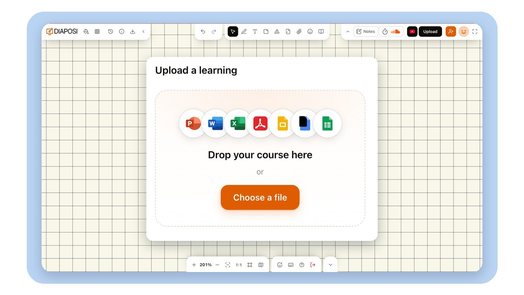
Sign in and drop the PDF, PowerPoint or Word file you study from, or take one from your Diaposi library. Typed notes work, and so do your lecturer's slides or handout. A scan of handwritten pages with no readable text cannot be used.
Shape a quiz on the lecture you just recalled
Choose Quiz. Diaposi finds the chapters of your file: take only the ones you have just recalled, then pick the kinds of question and the difficulty. To recall instead of recognising, add Fill in the blank and Numeric answer, where you type the answer.
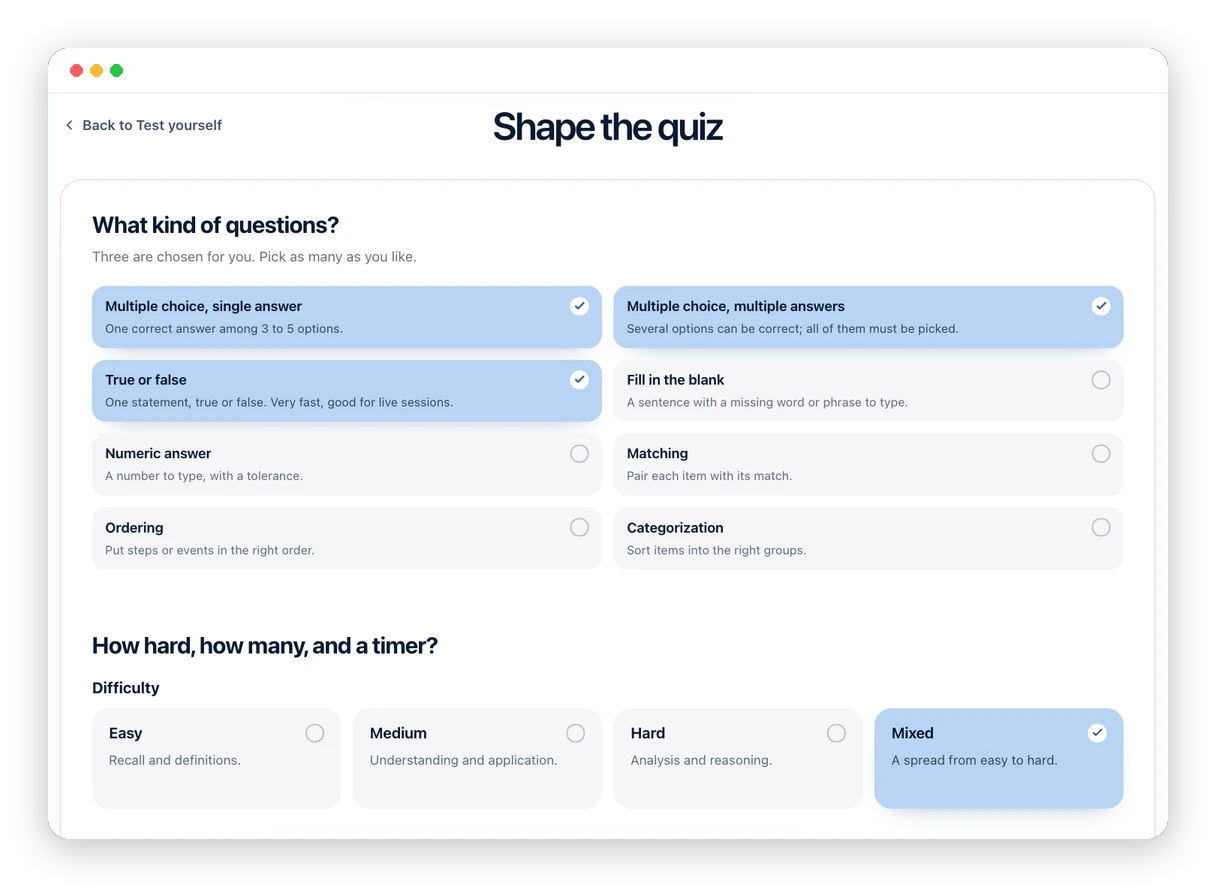
Answer with the notes closed, then read every correction
When you hand the quiz in, each question shows your answer, the right one and why, with the page of your notes it comes from. That page is your gap.
Let the misses come back as flashcards
Switch on Flashcards. After each card you grade your recall, Again, Hard, Good or Easy, and Diaposi sets when it comes back. Cards from pages you answered wrongly in the quiz come first. On your learning board you can write flip cards of your own from your paper gap list, or turn a page over: it hides while you say what was on it.
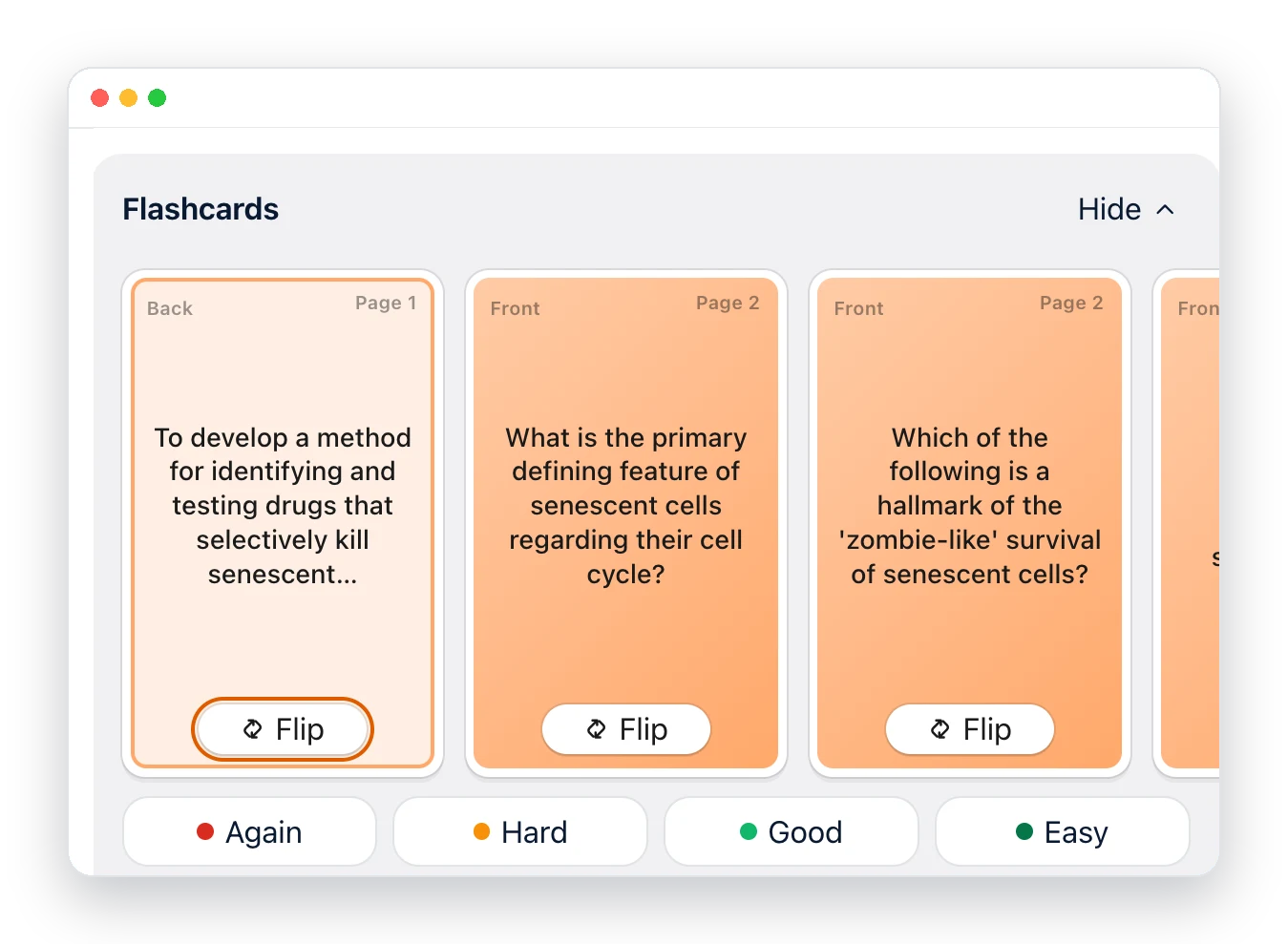
What it costs
- Free, for ever, no card: 10 credits to try the AI, 2 learning spaces, 1 quiz and 1 mock exam. The quiz can cover up to 4 documents, each up to 10 MB and 100 pages. Flashcards are on every plan; writing them uses credits.
- Credits pay for the AI's work on your documents. Free's 10 do not come back; a paid plan's come back every month.
- Starter fits a learner who tests themselves every week: €8.99 a month, or €5.99 a month billed once a year (€71.88), VAT included. 100 credits every month, 10 learning spaces, quizzes with your credits on up to 8 documents, results kept, and a retry of what you missed.
- Pro is €15.99 a month, or €9.99 a month billed once a year (€119.88): 200 credits every month, no limit on learning spaces, 10 friends invited, exports. Prices show in your currency on the pricing page.
On the site
- Quiz from your documents
How a quiz is written from your PDF, slides or notes: the chapters, eight kinds of question, and each answer explained with its page.
- Flashcards
Cards written from your own pages that come back on their own date, wrong answers first.
- Practice tests
The four ways to practise on the same pages: quick check, quiz, mock exam and flashcards.
Questions and answers
Is active recall the same as blurting?
Blurting is one form of it. The word is used mostly in the UK for the blank-page exercise: write everything you remember about a topic, then check it against your notes. Active recall is the wider idea and also covers answering questions, flashcards and practice tests.
Can I do active recall with lecture slides instead of notes?
Yes. The method is the same and the slides become the answer key. Slides often hold less than what was said, so when a slide is three words long, check the gap against the recording or the course book before you write the question.
Is rereading or highlighting my notes a waste of time?
Not a waste, but a poor main method. A review of ten study techniques rated rereading and highlighting as low utility, because they do not consistently improve results, and rated practice testing and spreading study over time as high utility (Dunlosky et al., 2013). Read once to understand, then close the notes.
Can AI write the recall questions from my notes?
Yes, and it saves the writing, not the recalling. A tool can only use what is in the file, and a generated question or answer can be wrong, so check it against your notes. In Diaposi each corrected answer shows the page it comes from, and the app itself says that Diaposi AI can make mistakes.
What is Diaposi?
Diaposi is a French EdTech ecosystem for interactive presentations and augmented learning: hosts run live polls, quizzes and anonymous questions on the PowerPoint, PDF or Word file they already have, and learners study their own documents with AI explanations, quizzes and mock exams. This guide uses the learner side.
Sources
5
- Roediger HL, Karpicke JD (2006). Test-enhanced learning: taking memory tests improves long-term retention. Psychological Science, 17(3), 249-255. doi.org/10.1111/j.1467-9280.2006.01693.x (external link)
- Karpicke JD, Blunt JR (2011). Retrieval practice produces more learning than elaborative studying with concept mapping. Science, 331(6018), 772-775. doi.org/10.1126/science.1199327 (external link)
- Rowland CA (2014). The effect of testing versus restudy on retention: a meta-analytic review of the testing effect. Psychological Bulletin, 140(6), 1432-1463. doi.org/10.1037/a0037559 (external link)
- Cepeda NJ, Vul E, Rohrer D, Wixted JT, Pashler H (2008). Spacing effects in learning: a temporal ridgeline of optimal retention. Psychological Science, 19(11), 1095-1102. doi.org/10.1111/j.1467-9280.2008.02209.x (external link)
- Dunlosky J, Rawson KA, Marsh EJ, Nathan MJ, Willingham DT (2013). Improving students' learning with effective learning techniques: promising directions from cognitive and educational psychology. Psychological Science in the Public Interest, 14(1), 4-58. doi.org/10.1177/1529100612453266 (external link)