How do you revise when your course has no past papers?
You write the paper yourself. A new module has no past papers, some professors release no practice exam, and one specimen paper is soon used up. What is missing is the questions, not the method.
An exam is three things: questions in a known format, a clock and a marking guide. You can build all three from your lecture notes.
Find the format of the real exam
Its length, its kinds of question, the marks for each, and whether you choose among questions.
List what can be asked
One line per lecture or learning outcome. Each line gets a question, or is left out on purpose.
Write the questions
In the format of the real paper, spread across the whole list.
Write the marking guide
For each question, the points a full answer must make, one mark each, with the page of your notes. Before you answer anything.
Sit it
Two days later or more, against the clock, notes closed, in one sitting.
Mark it the next day
Against the guide. A mark only for a point that is written on the page.
Use the result
Sort the lost marks by cause, relearn the weakest chapter first, then test it again.
How do you find out what the real exam looks like?
Ask for the format, not the questions. A lecturer who keeps old papers back will often say how the paper is built, and the module handbook may say it already.
| What to find out | Where to look | What it sets in your mock |
|---|---|---|
| How long the exam lasts | Module handbook, exam timetable | The time on your clock |
| The kinds of question | Handbook, lecturer, specimen paper | Multiple choice, short answers, essays or problems |
| The number of questions and their marks | Exam instructions, lecturer | The minutes you have per mark |
| Whether you choose among questions | Exam instructions | The same choice on your paper |
| What is allowed in the room | Exam rules | Open or closed book, formula sheet, calculator |
| What the course stressed | Learning outcomes, revision lecture | Which topics get a question |
222 studies
In a meta-analysis of 222 classroom studies and 48,478 students, from primary school to university, quizzing raised achievement by about half a standard deviation. The gain was larger when the quiz had the format of the final exam (g = 0.531) than when the formats differed (g = 0.399).
Source: Yang C, Luo L, Vadillo MA, Yu R, Shanks DR (2021) (external link)
If nobody will tell you the format, build a mixed paper: some multiple choice, a few short answers and one long question. In those studies, where instructors set the quizzes, practice in another format still helped, only less (Yang et al., 2021 (external link)).
A mock can be shorter than the exam if it keeps its pace: if the real paper gives two hours for 100 marks, a 30-minute mock holds 25 marks.
How do you write exam questions from your lecture notes?
Start from what the course says you must be able to do: the learning outcomes, the lecture titles, the questions your lecturer asked aloud. Turn each one into a question with an exam command word. Where the course already has questions, reuse them: tutorial sheets, the textbook's end-of-chapter questions, the examples worked in lectures.
Exam question stems to copy
- Define ... and give one example from the course.
- Explain why ... happens.
- Compare ... and ...: two differences, one similarity.
- Calculate ..., showing your working.
- Apply ... to this case: ...
- To what extent is ... true? Argue both sides.
- Which of these four statements about ... is correct, and why are the other three wrong?
Then fit the format. For multiple choice, take the wrong options from your own mistakes: an option nobody would pick tests nothing. For a problem, change the numbers of a worked example. For an essay, the guide is a plan of the argument.
Write the guide with your notes open, a page number beside each point. A question you cannot write a guide for shows a gap in your notes: fill it now.
Your own paper has two flaws. You favour what you already know: the list of lectures corrects that. And you remember your questions: wait two days before sitting it, or swap papers with a classmate.
How do you sit a mock exam so that it counts?
Like the real one: the same pace, notes closed unless the exam is open book, phone in another room, one sitting, by hand if the exam is on paper. Answer every question and guess when unsure: a blank says nothing about what you half know.
61% against 40%
In a laboratory experiment with 180 undergraduates, those who studied a short text once and then took three recall tests recalled 61% of it a week later. Those who studied it four times recalled 40%.
Five minutes after studying, the order was the other way round, and those who had only restudied were the more confident (Roediger and Karpicke, 2006 (external link)). Rereading feels safer that evening. Recall is what lasted the week.
How do you mark your own mock exam honestly?
Mark it the next day, against the guide. By then you read what is on the page, not what you meant, and the guide was fixed before you wrote a word.
- One mark per point written on the page. A point you only had in mind earns nothing.
- Three verdicts per question: full, part or none. For part, write which point is missing.
- A right answer reached by a guess is marked right and circled, to test again.
- For an essay, mark the argument step by step, then the evidence for each step.
- If you can, swap scripts with a classmate, who does not know what you meant.
- Add up the marks on the scale of your own exam and date the result.
A mark alone tells you little about what to change. In a 2020 meta-analysis of 435 studies and more than 61,000 learners, feedback that only rewarded or punished had a small effect (d = 0.24). Feedback rich in information, on what was wrong, why, and what to do next time, had a large one (d = 0.99) (Wisniewski, Zierer and Hattie, 2020 (external link)).
The studies vary widely, and the feedback usually came from an instructor. Here you are the marker, so write the reason beside every lost mark.
What do you do with the result of a mock exam?
Sort every lost mark by its cause. Each cause has its own repair, and only the first is more reading.
| Why the mark was lost | What to do |
|---|---|
| You never learned it | Relearn that part from your notes, then answer a new question on it. |
| You learned it and could not recall it | Do not reread it. Answer questions on it, notes closed, on two more days. |
| You knew it and answered another question | Underline the command word in each question before you write. |
| You ran out of time | Write the minutes for each question on the paper, and move on when they are spent. |
| A slip: a sign, a unit, a skipped line | Keep the last five minutes for checking. |
Take the chapters weakest first, and test each again with new questions: on the same paper you would recite your last answers. Leave a gap before that test. In an experiment with more than 1,350 people, who learned trivia facts, reviewed them once and were tested later, the best gap before the review was about one to three days when the test came a week after it. Too short a gap cost much more than too long a one (Cepeda et al., 2008 (external link)).
One review of simple facts gives a rule of thumb, not a calendar: a day or more, not the same evening.
A timed mock exam on your own course, written and marked for you
A mock exam needs your exam's format, a clock and a marking guide fixed in advance. The slow parts are writing the paper and marking your own written answers. Diaposi's practice tests do both on the files you already have: the questions are written from your own pages, in their language, and each corrected answer names its document, chapter and pages.
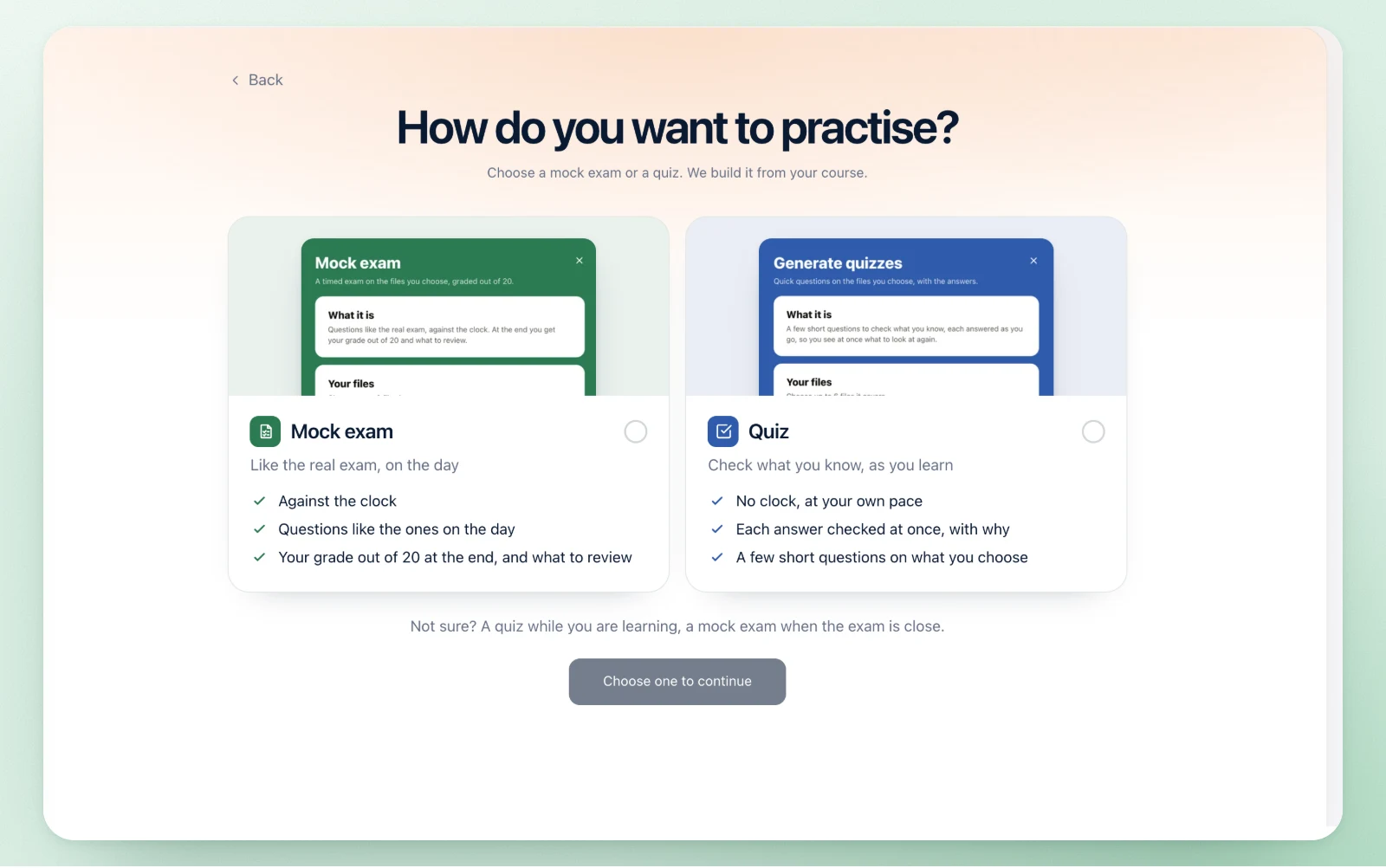
Choose Mock exam and add your course
Sign in, pick Mock exam, and add the PDF, PowerPoint or Word files of the course, or take them from your library. A scanned file with no readable text cannot be used.
Set it like your real exam
Diaposi finds the chapters: take all or some. Choose the format: Smart Mix, objective questions only, a written examination, or your own choice among multiple choice, open answers and problem-based questions. Then the level of thinking and the time: 15, 30, 45, 60 or 90 minutes, or left to Diaposi.
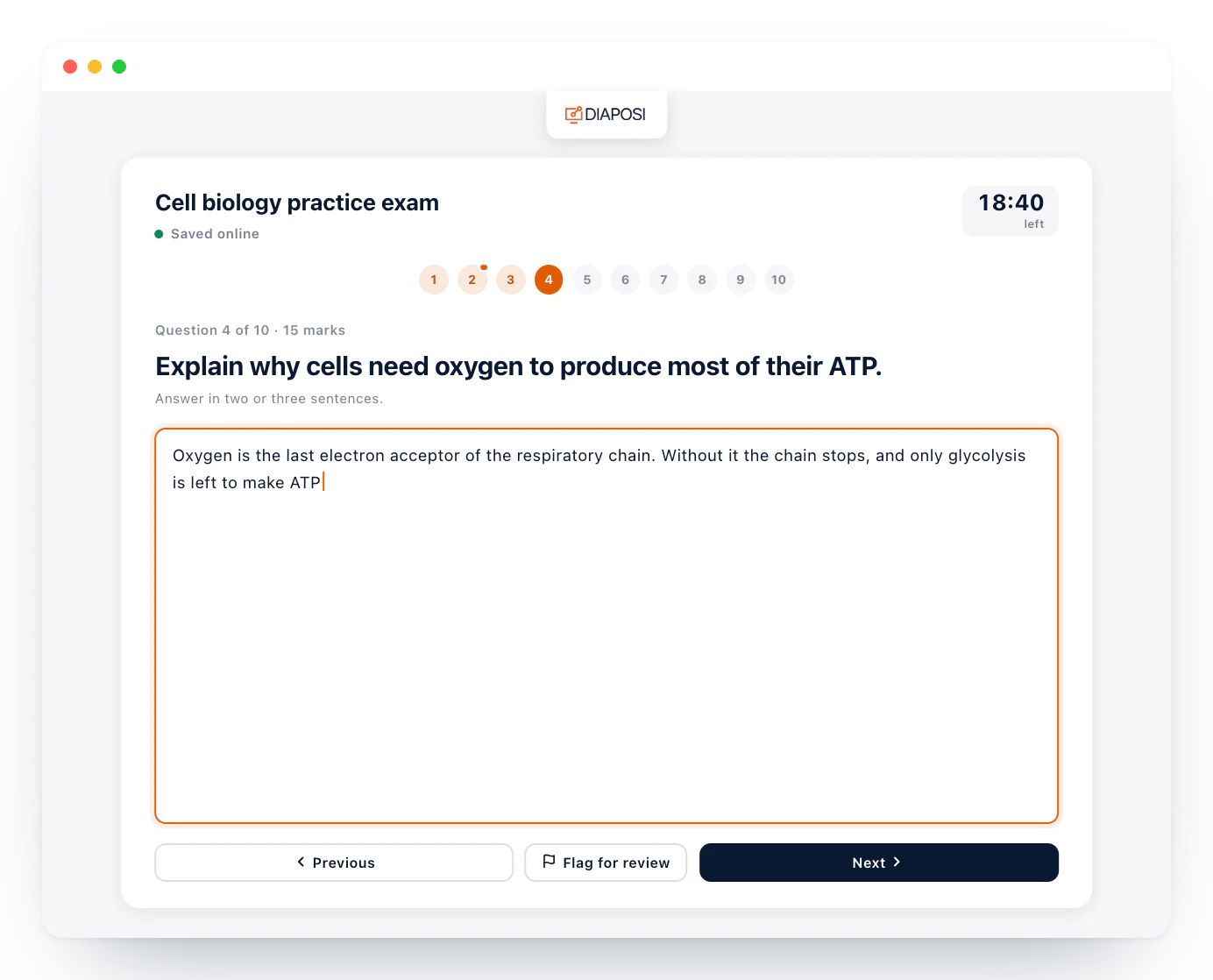
Sit it against the clock
The clock runs while you answer. Flag a question to come back to it, and review before you hand in. You can pause the clock: to rehearse the real thing, do not.
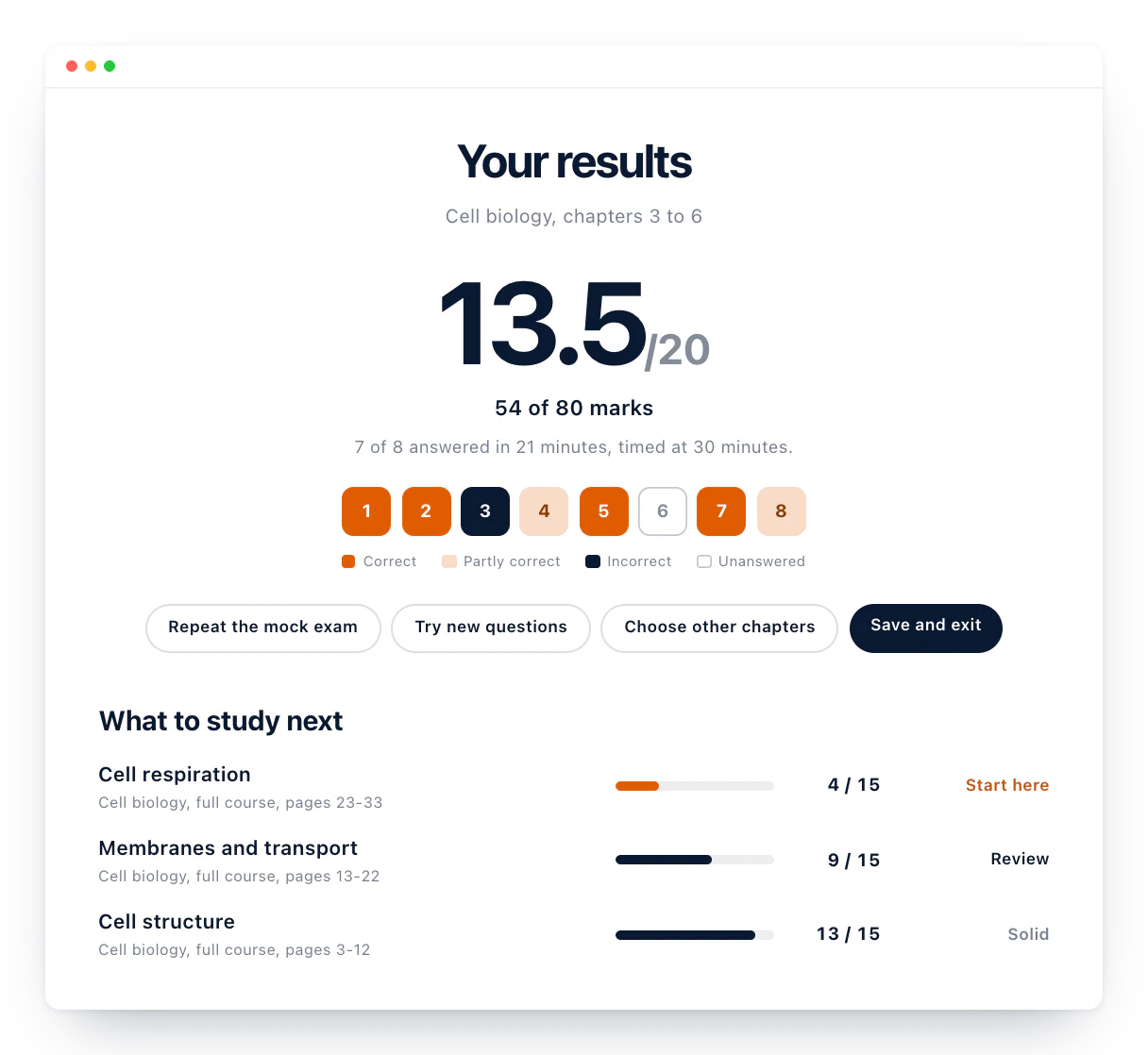
Read your grade out of 20, then every answer
Objective questions are corrected automatically. Each written answer is marked against the points it had to make: you see which are met and which are not yet demonstrated, with the expected answer beside yours. On a paid plan, the results rank your chapters, weakest first, and you can retry what you missed or ask for new questions.
What it costs
- Free, for ever, no card: 1 mock exam and 1 quiz, with 10 credits to try the AI and 2 learning spaces. One mock exam covers up to 4 documents, each up to 10 MB and 100 pages.
- Starter is the plan for a set of exams on your own: €8.99 a month, or €5.99 a month billed once a year (€71.88), VAT included. 100 credits every month, and a mock exam written takes 2. Up to 8 documents per mock exam, files up to 50 MB and 250 pages, results kept, papers sat again.
- Pro is €15.99 a month, or €9.99 a month billed once a year (€119.88): 200 credits every month, 10 friends invited to sit the same mock exam, and results exported as PDF, Excel or CSV.
- Prices are shown in your currency on the pricing page.
On the site
- Mock exam out of 20
The formats, the timer and how written answers are marked on their criteria.
- Practice tests
Quick check, quiz, mock exam and flashcards on the same pages, and what each one is for.
- Quiz from your documents
Short questions on the chapters you choose, for the weeks before the mock.
Questions and answers
Is it too early to sit a mock exam if I have not finished revising?
No. Sit a first one early and expect a low mark. In five laboratory experiments on one short essay, people who were asked questions before reading it did better on a later test than people given extra reading time, even on questions they first got wrong (Richland, Kornell and Kao, 2009). A wrong answer is not wasted if you then read the right one.
How many mock exams should I sit before the real one?
More than one, if time allows. In classroom studies, the more often content was quizzed, the larger the gain (Yang et al., 2021). They need not all be full length: after one full mock, sit papers of 20 or 30 minutes on your weakest chapters, with new questions, at the real exam's pace.
Can AI write a mock exam from my lecture notes?
Yes, and it saves the slowest part: writing the questions and their guide. Check three things. The questions come from your course, not from the subject in general. They have the format of your exam. And each answer can be traced to a page, because a generated answer can be wrong. In Diaposi, each corrected answer names its document, chapter and pages.
Does my mock exam mark predict my real mark?
No. It covers the questions of one sitting, and on a paper you wrote it also reflects your guess at what will be asked. Use it to rank your chapters and to compare one sitting with the next. Diaposi says the same of its grade out of 20: it is practice feedback, and does not predict an official exam.
What is Diaposi?
Diaposi is a French EdTech ecosystem for interactive presentations and augmented learning: hosts run live polls, quizzes and anonymous questions on the PowerPoint, PDF or Word file they already have, and learners study their own documents with AI explanations, quizzes and mock exams. This guide uses the learner side.
Sources
5
- Roediger HL, Karpicke JD (2006). Test-enhanced learning: taking memory tests improves long-term retention. Psychological Science, 17(3), 249-255. doi.org/10.1111/j.1467-9280.2006.01693.x (external link)
- Yang C, Luo L, Vadillo MA, Yu R, Shanks DR (2021). Testing (quizzing) boosts classroom learning: a systematic and meta-analytic review. Psychological Bulletin, 147(4), 399-435. doi.org/10.1037/bul0000309 (external link)
- Wisniewski B, Zierer K, Hattie J (2020). The power of feedback revisited: a meta-analysis of educational feedback research. Frontiers in Psychology, 10, 3087. doi.org/10.3389/fpsyg.2019.03087 (external link)
- Cepeda NJ, Vul E, Rohrer D, Wixted JT, Pashler H (2008). Spacing effects in learning: a temporal ridgeline of optimal retention. Psychological Science, 19(11), 1095-1102. doi.org/10.1111/j.1467-9280.2008.02209.x (external link)
- Richland LE, Kornell N, Kao LS (2009). The pretesting effect: do unsuccessful retrieval attempts enhance learning? Journal of Experimental Psychology: Applied, 15(3), 243-257. doi.org/10.1037/a0016496 (external link)