Why don’t students ask questions in lectures?
Because asking in front of a full room costs more than it seems to give. The questions exist. What is missing is a safe way to ask them.
47.7%
In a survey of 417 undergraduates at one US research university, 47.7% said they never ask a question in their large science courses during a whole semester, although more than 90% said other people’s questions help them.
The same survey asked the 361 students who never or rarely ask what holds them back. They could choose several reasons; the wording below is shortened.
| What discourages asking | Share who chose it |
|---|---|
| I feel anxious when I ask questions | 72.3% |
| I worry others will judge me | 62.0% |
| I can ask another student during class | 57.3% |
| I can look up the answer myself | 56.8% |
| I do not know the material well enough to ask a good question | 53.1% |
| I can ask the instructor outside class | 50.7% |
| It would take away from other students’ class time | 32.4% |
| Another student will likely ask my question | 23.6% |
| I would not get a detailed enough answer in the time there is | 21.7% |
Source: Nadile et al., PLOS ONE, 2021 (external link), table 3. Two families of reasons stand out. The first is fear: anxiety, being judged, a question that does not feel good enough. The second is a way round: a neighbour, a search, or a word with you outside the lecture, where the answer reaches one person instead of the room.
These figures come from one university, from science courses, and from what students say about themselves: a pattern to check in your own room, not a law.
Who stays silent, and does the size of the room matter?
Silence is not spread evenly. Observers who sat in 34 university life sciences classes found that, in an average session, 32% of the men and 22% of the women present spoke at least once (Bailey et al., 2020 (external link)). That is one university, and it counts every spoken contribution, not only questions. Either way, most of the room said nothing.
The survey points the same way: women were 2.4 times more likely than men to report never asking a question (Nadile et al., 2021 (external link)).
Size widens the gap. Across more than 5,300 observed exchanges between students and instructors in STEM courses, class size was the factor that most reduced women’s participation (Ballen et al., BioScience, 2019 (external link)).
Group work does not fix this by itself. Even in a course built on active learning, men spoke more than their share of the room, above all when answers were volunteered aloud after group discussion (Aguillon et al., 2020 (external link)). While the only channel is a voice in front of everyone, the same people tend to use it.
Does silence mean everyone understood?
No. Silence tells you that asking felt too costly, not that the slide was clear. Of the 376 students in the survey who said other people’s questions help them, 96.0% said they sometimes have the same question, and 77.7% that they sometimes feel uncomfortable asking themselves (Nadile et al., 2021 (external link), table 2). A question kept back is a loss for the room, not for one person.
It costs you too. A question is the cheapest signal you get about where an explanation failed, and when only a few confident voices ask, the lecture gets tuned to them.
What can you change this week, without any tool?
Each move below lowers the cost of asking, and none needs a screen.
Put the question stop on a slide
Plan two or three stops inside the lecture, each on a slide of its own. A stop at the very end competes with people packing their bags.
Count to five
A review of classroom research on wait time found that, after asking a question, the person teaching typically waits less than one second for a reply (Rowe, 1986 (external link)). Count silently to five before you speak again. It will feel long.
Let neighbours talk first
Give the room one minute to agree on one question with a neighbour. In the survey, 57.3% of those who never or rarely ask said they can ask another student instead. Use that habit: a question shared by two is easier to say aloud.
Collect questions on paper
Hand out slips or index cards and collect them unsigned, at a stop or at the door. Nobody is seen asking, and nobody has to speak. Open the next lecture with the questions that came up most.
Invite, do not pick
Calling on someone who has not volunteered does not make speaking safer. In interviews with 52 students in large science courses, cold call and random call were said to raise anxiety, never to lower it (Cooper, Downing and Brownell, 2018 (external link)). Ask which pair will share its question, then wait. Keep the paper slips for those who will not.
Answer the first question well
Repeat it so the whole room hears it, thank the person, answer briefly. The first exchange shows everyone else what asking will cost them.
Six things to say instead of “Any questions?”
- What was the least clear point so far? Write it down, then compare with your neighbour.
- Which step could you not redo alone tonight?
- What question do you think someone near you has?
- If this came up in the exam, which part would you want explained again?
- What should I say a second time, more slowly?
- I will take three questions before the next part. I will wait.
Do written, anonymous questions bring more questions?
Probably, though no study cited here tested it in a lecture hall. The research on anonymity is about answering, and it points one way. When 128 students answered opinion questions anonymously on a keypad instead of raising a hand, their answers followed the group less, and the shyest students said they preferred the keypad (Stowell, Oldham and Bennett, 2010 (external link)).
In lectures at three universities, participation differed significantly between keypads and raised hands, and students said the keypad’s anonymity made them take part more (Barr, 2017 (external link)). Both studies used hardware keypads. What carries over to a phone is the mechanism: nobody sees who answered.
A written channel changes the picture too. In live online classes during the pandemic, only 14% of surveyed students at one US university and 10% at an Australian one said they asked questions by raising a hand, while 55% used the chat (Salehi et al., PLOS ONE, 2023 (external link)). Those were online classes, not lecture halls, so take the direction, not the numbers.
Put together, four properties look worth having: the question is written, anonymous, open to votes, and sent at any moment. The table sets each cause against a way to lower it.
| What holds people back | Without a tool | With written, anonymous questions on phones |
|---|---|---|
| Anxiety, fear of being judged | Unsigned paper slips | The question arrives without a name |
| “My question is not good enough” | A minute with a neighbour first | Votes show that others share it |
| “It would take class time” | Question stops planned on slides | Sent at any moment, answered at the stop |
| “Someone else will ask” | One written question per pair | One tap to vote for a question already asked |
| “I will ask after the lecture” | Answer after-class questions for everyone at the start of the next lecture | Asked during the lecture, answered for the whole room |
Two limits. Paper is slow in a large hall, and nobody sees that a neighbour had the same question. And an anonymous channel needs a rule: you read it at the stops, and you take out what does not belong.
Take anonymous questions on the slides you already have
Anxiety and the fear of being judged were the reasons chosen most in the survey, and both come from being seen. In Diaposi, you present the PowerPoint, PDF or Word file you already have from the browser, the room joins on phones, and questions arrive in writing, anonymous by default, with votes. There is no add-in for you and no app for them.
Upload the deck you already have
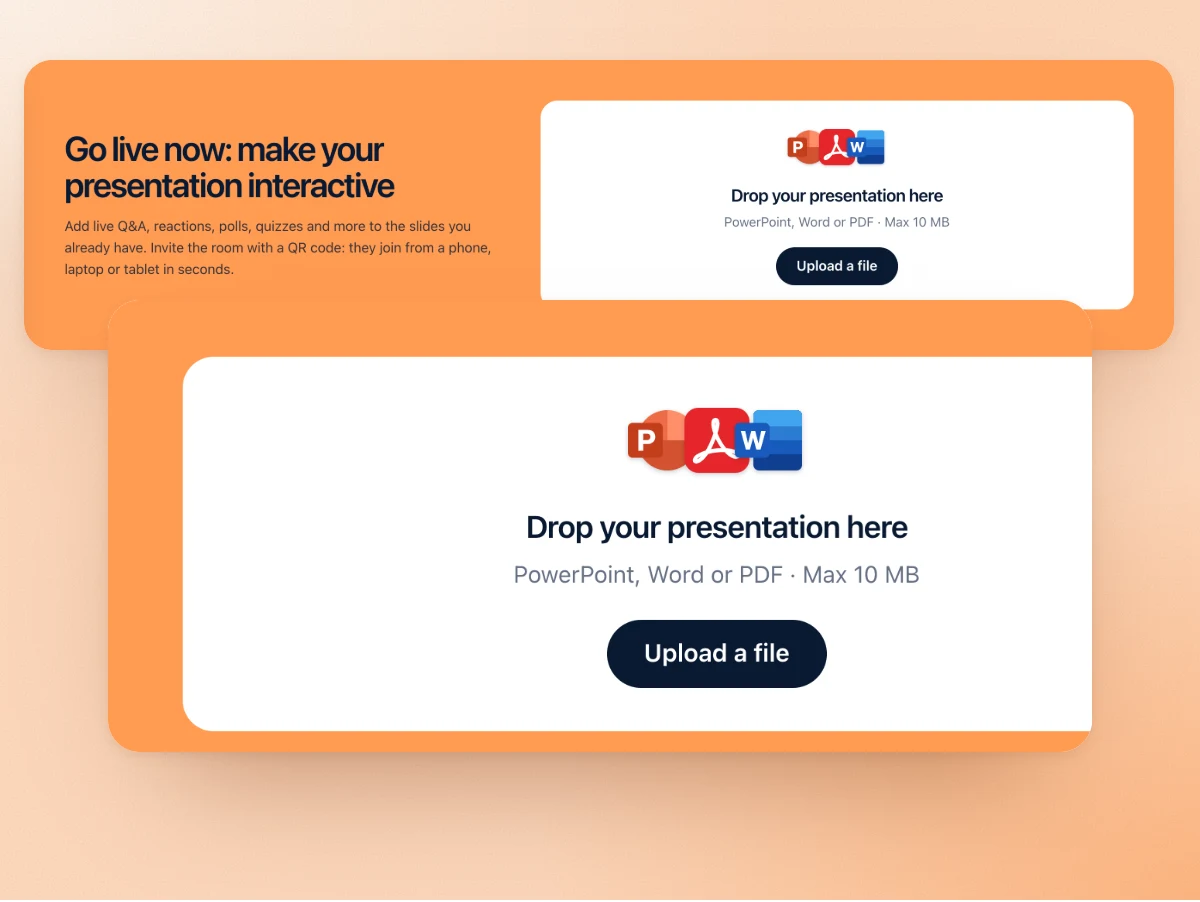
Sign up, then drop your PowerPoint, PDF or Word file (10 MB at most) on Host a session and answer two setup questions. The deck is presented from the browser as it is.
Show the code and let the room write
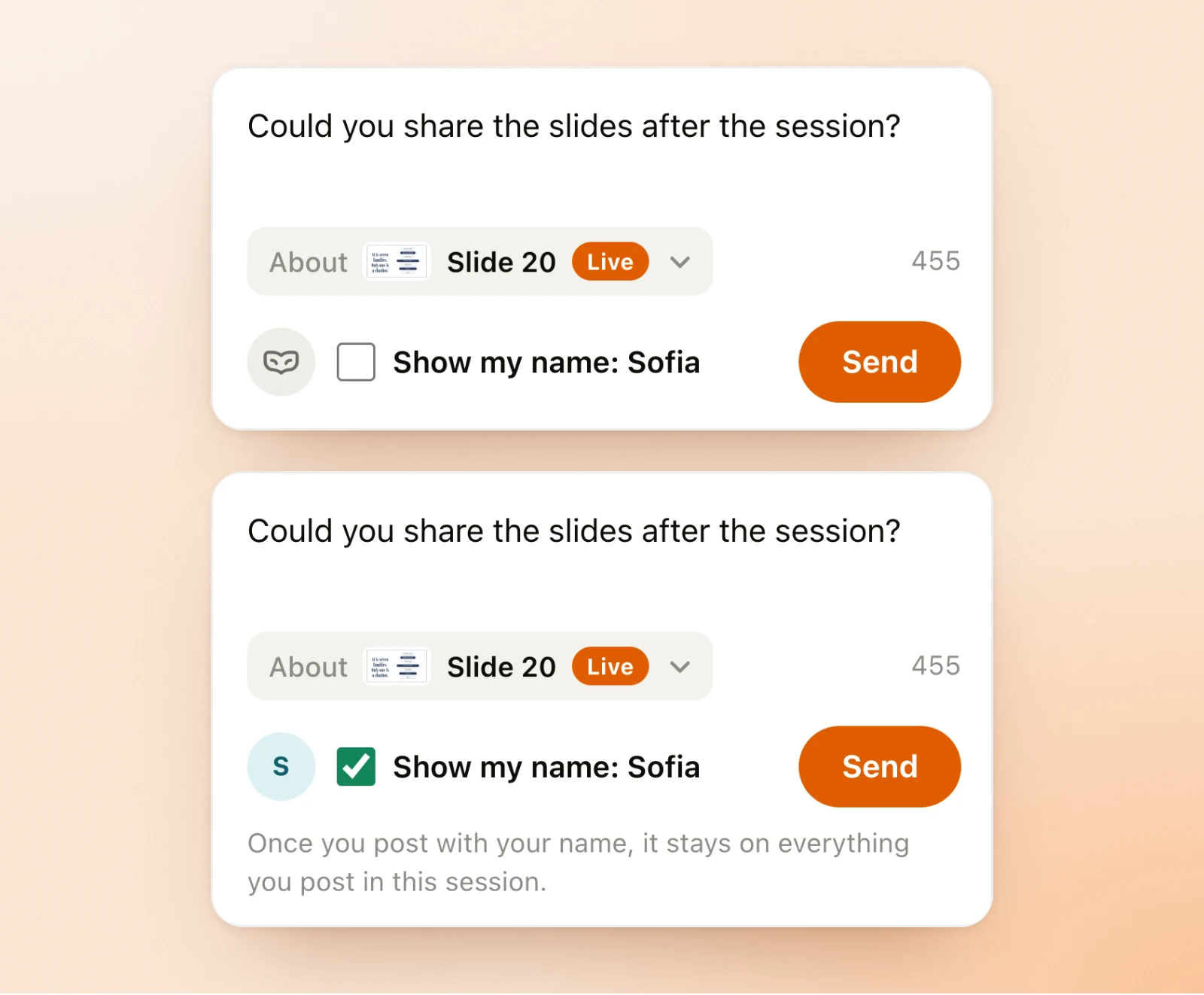
Participants scan the QR code or type the 8-digit code at diaposi.com, with no account, and give a name once. They see your slides on their phone and type a question about the slide in front of them. It arrives without a name unless its author ticks Show my name, a choice that then holds for the session.
Let the room vote
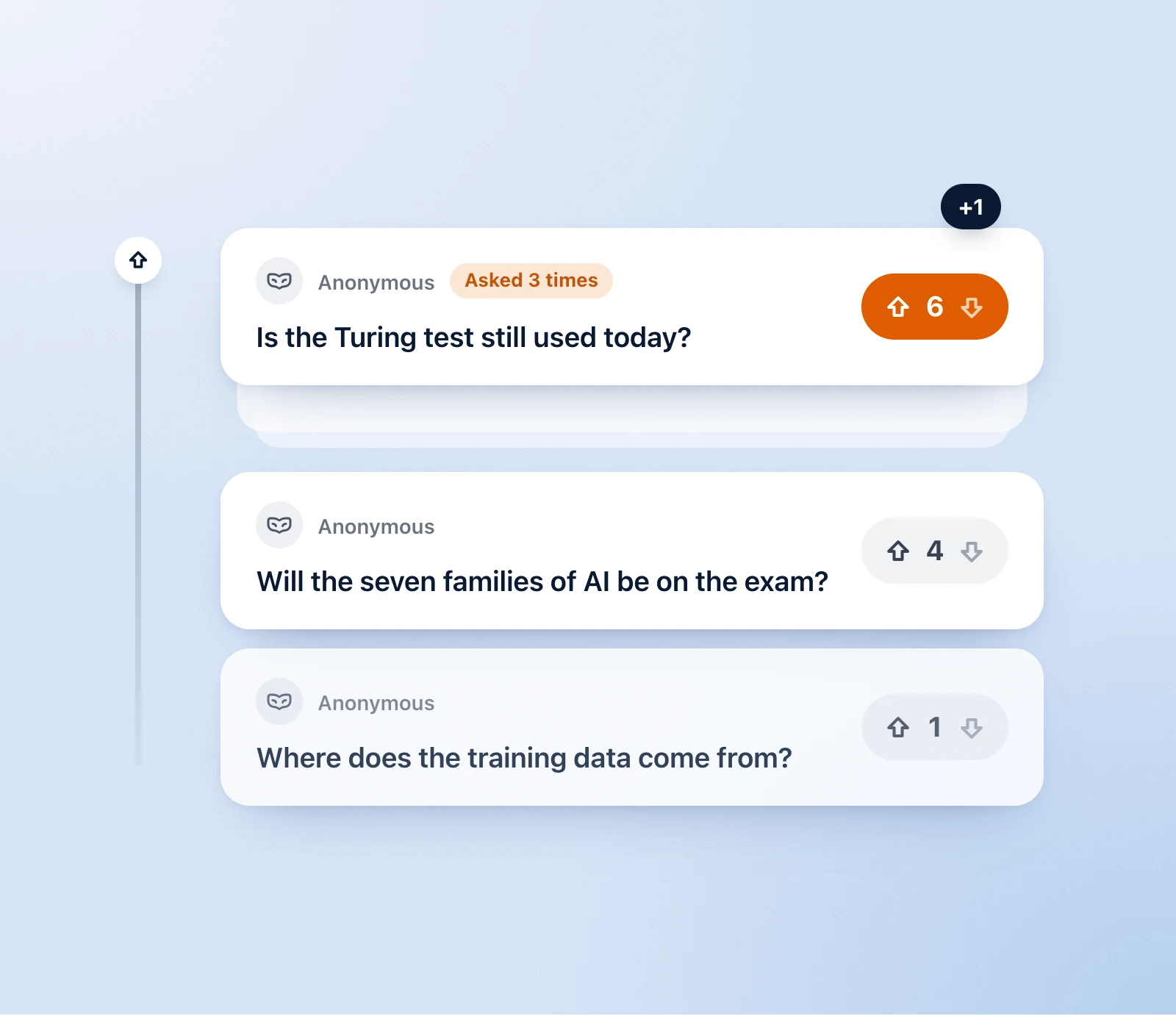
The room votes questions up or down, and the same question asked twice is counted once, with its number. It answers “someone else will ask” and “my question is not good enough”: one tap shows that a question is shared.
Answer the top questions at your stop
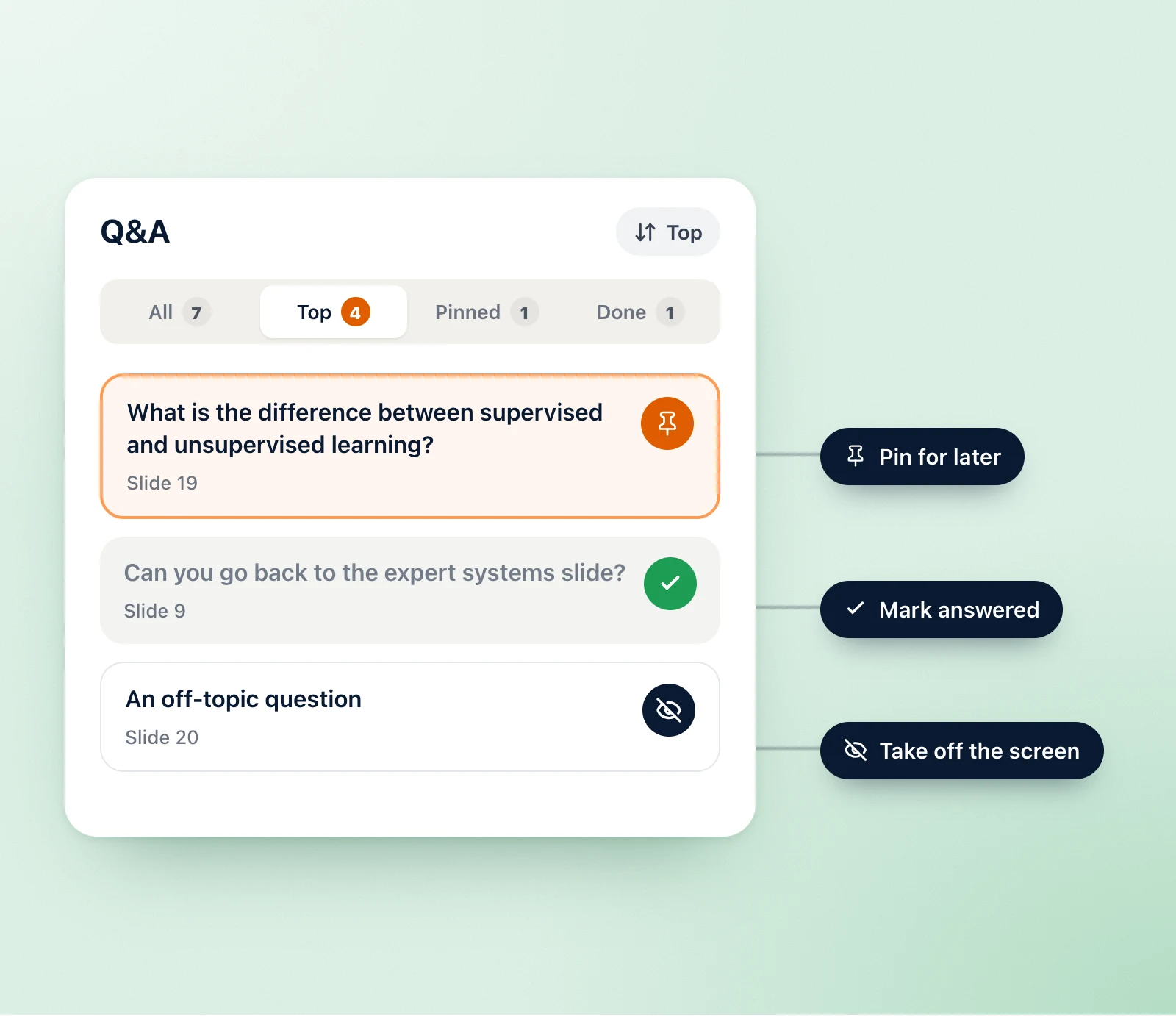
Open the Q&A panel beside the slide with one key; the room’s screens keep the slide. Sort by Top, pin a question for later, mark one answered, take an off-topic or offensive one off the screen. Every question stays in the session report with its slide, its time and its votes.
What it costs
- Hosting is free during the beta, with no card: your slides with live questions, polls and quizzes, and a report after every session.
- Participants never pay. They join with a code, with no account and no app.
- The paid host plans are not for sale yet: you can join the waitlist, and a school or a company can contact us.
On the site
- Anonymous Q&A
How questions, votes and the host’s panel work, screen by screen.
- Live interactive presentation
Everything a session adds to your slides: Q&A, polls, quizzes and the report.
- For education
Diaposi for higher education: an interactive lecture from the document you already use.
Questions and answers
Does asking “Any questions?” at the end of a lecture work?
Not well. It comes when people are packing up, it asks them to speak in front of everyone, and it seldom gets enough silence: in classroom research, the person teaching typically waits less than one second for a reply after asking a question (Rowe, 1986). Move the question stops inside the lecture, word them precisely, and wait five seconds.
Why are students afraid to answer questions in class?
Mostly because they fear being wrong in public. In a survey of 417 undergraduates, three out of four of those who never or rarely answer (75.6%) said they are not confident that their answer is correct (Nadile et al., PLOS ONE, 2021). The same fear holds back questions, so offer a first try in writing, without a name.
What if the room stays silent even with anonymous questions?
Make the first question a task, not an invitation. At the first stop, ask everyone to write the least clear point so far, then to vote for one question they share, and answer the top one at once. The aim is for people to see a question like theirs answered with nobody named.
Can participants stay anonymous in Diaposi, and what does the host see?
Yes. A question is anonymous by default and shows a name only if its author chooses Show my name; from then on, that name stays on what they post in the session. Reactions never carry a name. The host’s report lists participants by the name they gave when they joined, and keeps every question. Reports are kept 12 months after the session, then deleted.
What is Diaposi?
Diaposi is a French EdTech ecosystem for interactive presentations and augmented learning: hosts run live polls, quizzes and anonymous questions on the PowerPoint, PDF or Word file they already have, and learners study their own documents with AI explanations, quizzes and mock exams.
Sources
9
- Nadile EM, Alfonso E, Barreiros BM, Bevan-Thomas WD, Brownell SE, et al. (2021). Call on me: undergraduates’ perceptions of voluntarily asking and answering questions in front of large-enrollment science classes. PLOS ONE 16(1):e0243731. doi.org/10.1371/journal.pone.0243731 (external link)
- Bailey EG, Greenall RF, Baek DM, et al. (2020). Female in-class participation and performance increase with more female peers and/or a female instructor in life sciences courses. CBE Life Sciences Education 19(3):ar30. doi.org/10.1187/cbe.19-12-0266 (external link)
- Ballen CJ, Aguillon SM, Awwad A, et al. (2019). Smaller classes promote equitable student participation in STEM. BioScience 69(8):669-680. doi.org/10.1093/biosci/biz069 (external link)
- Aguillon SM, Siegmund GF, Petipas RH, Drake AG, Cotner S, Ballen CJ (2020). Gender differences in student participation in an active-learning classroom. CBE Life Sciences Education 19(2):ar12. doi.org/10.1187/cbe.19-03-0048 (external link)
- Rowe MB (1986). Wait time: slowing down may be a way of speeding up. Journal of Teacher Education 37(1):43-50. doi.org/10.1177/002248718603700110 (external link)
- Cooper KM, Downing VR, Brownell SE (2018). The influence of active learning practices on student anxiety in large-enrollment college science classrooms. International Journal of STEM Education 5:23. doi.org/10.1186/s40594-018-0123-6 (external link)
- Stowell JR, Oldham T, Bennett D (2010). Using student response systems (“clickers”) to combat conformity and shyness. Teaching of Psychology 37(2):135-140. doi.org/10.1080/00986281003626631 (external link)
- Barr ML (2017). Encouraging college student active engagement in learning: student response methods and anonymity. Journal of Computer Assisted Learning 33(6):621-632. doi.org/10.1111/jcal.12205 (external link)
- Salehi S, Ballen CJ, Bolander Laksov K, Ismayilova K, Poronnik P, Ross PM, Tzioumis V, Wieman C (2023). Global perspectives of the impact of the COVID-19 pandemic on learning science in higher education. PLOS ONE 18(12):e0294821. doi.org/10.1371/journal.pone.0294821 (external link)